Deployable Optical Receiver Aperture (DORA): experiments in Radio and Optical communications

DORA Experiments in Communications and Cosmology

DORA was a joint mission supported by NASA, ASU’s Low frequency Cosmology Lab (LoCo), and Amateur radio enthusiasts. The satellite was a platform for experiments in the related fields of communications and cosmology. The mission and radio payload were led by the LoCo lab, the bus and optical experiment was built by students and staff in ASU’s Interplanetary Lab.

Amateur Radio Service

DORA is built and operated by amateur radio enthusiasts at Arizona State University and the Phoenix area. The cubesat avionics have been built by undergraduate students at ASU, all of whom, as a part of the program, have obtained Amateur operating licenses. The radio system is an OpenLST, an open source telemetry radio originally developed by Planet Labs and updated by ASU’s Interplanetary Lab.  The satellite was operated by amateurs as a packet radio node using software defined radio code.  Many operators around the world participated via the SatNOGS network.

VHF Spectrometer (RBE-1)

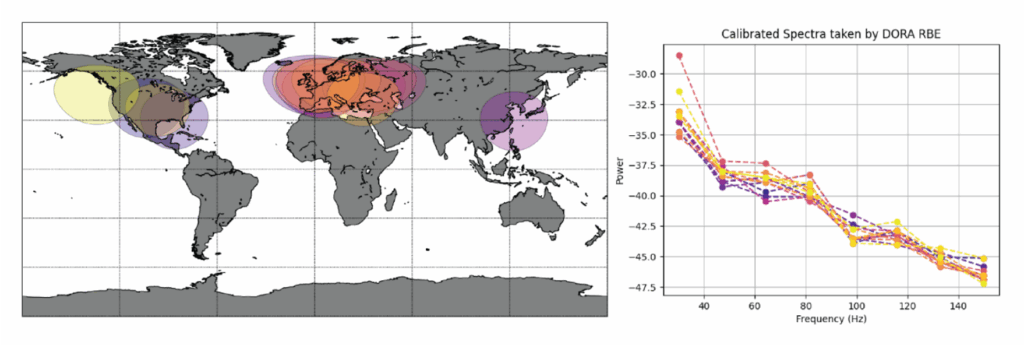
The goal of the VHF spectrometer, code named Radio Background Explorer 1,  was to test technology for precision absolute calibration developed originally for the EDGES 21cm cosmology experiment. A secondary goal was to map use of the radio spectrum in the 2 to 4 meter band. The instrument provided a first test of the compact switches and other technology needed to perform EDGES-type measurements in space. The device includes two radio spectrometer targeting the VHF band with a deployable monopole antenna. The COARSE spectrometer is a switched filter bank which measures power in 20 MHZ channels from 50 to 120MHz.  The FINE spectrometer is a Noelec RTL SDR read out by a raspberry Pi. A programmable bank of switches can route signals to either of these two instruments or to calibration loads as desired.

Hardware

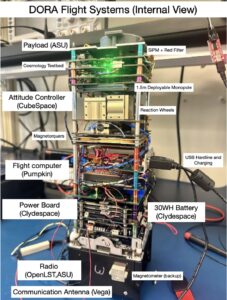
DORA Cubesat components

Radio Background Experiment 1. Testbed for raising TRL of precision calibrated low frequency radio receiver for 21cm global experiments.

Integration and Test


Flight


Data

The pointing system was forecast to take one month to fully commission.  A blown LNA at the ground station added time to this process. See Lalonde et al 2025 for details. This was within margin under the nominal mission orbit lifetime of 6 months. However, extreme solar activity shortened the orbital lifetime to 56 days.  With one week till predicted re-entry, attitude control commissioning was curtailed and taking advantage of favorable power circumstances RBE1 was activated.  With high speed download offline due to continuing problems with reception at ASU ground station, data were collected via beacon readings collected by members of the SatNOGS network.  Baseline mission for RBE1 was to advance TRL of precision self-calibrated receivers for space-based 21cm global signal measurements and other related applications.   Power measurements through the RBE1 coarse band spectrometer indicate correct operation of the spectrometer switch network, excellent stability of the signal chain, and overall good performance of the spectrometer computer system. Attempts to deploy the science antenna were not immediately successful. The issue was traced to a software problem. Attempts to fix the problem via an uploaded patch were under way when re-entry occurred.
Optical Receiver

The technology concept motivating the mission is the deployable optical receive aperture (DORA) for inter-spacecraft communications. Theoretically this  architecture could maintain Gb laser communications on an unstable platform at a range up to 1000km. The novel DORA approach enables a large collecting area and eliminates precision pointing accuracy requirements on the host spacecraft. It is ideally suited for crosslink communications among small spacecraft, especially for those forming a swarm and/or a constellation, and for surface to orbit communications. The DORA system will enable the host spacecraft to overcome constraints imposed by traditional optical communications systems that require high-precision bus pointing on the order of arcseconds. DORA requires a host pointing accuracy of 10°, allowing the primary mission to continue without reorienting to communicate and/or enabling small satellite missions using low-cost off-the-shelf ADCS systems.  As a part of the DORA cubesat project, a prototype transciever was designed and tested on the bench. The flight mission aimed to measure backgrounds due to cities in the near infrared band and gain experience using solid state photodiode detectors in a space environment.

Cubesat design

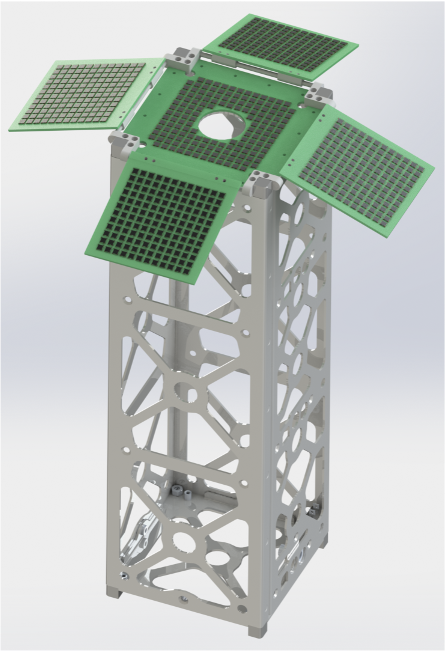
The technology development objective is to build a cubesat demonstration of a wide-field laser terminal that provides a sustained 1 Gbps data rate over 1000 km, while requiring only 10 degree spacecraft bus pointing accuracy and stability.  The cubesat contained standard commercial subsystems for the electrical and power system, attitude control and determination system, GPS receiver and antenna, onboard computing, and UHF radio and antenna. The 3U spacecraft used a novel exoskin design with ultrathin foldflat solar panel wings. The attitude system included full reaction and magnetorquer actuated control with optical sun tracking camera and IR limb tracking.  All major subsystems were supplied by commercial vendors connected via in-house glue logic. The avionics took up about 2U of space total.

Images by Jaime Sanchez De La Vega Covarrubias.

Initial design of DORA cubesat.

DORA instrument block diagram.
 

The DORA project is managed and funded by the Small Spacecraft Technology (SST) program within the Space Technology Mission Directorate. The SST expands U.S. capability to execute unique missions through rapid development and in space demonstration of capabilities for small spacecraft applicable to exploration, science, and the commercial space sector. The SST enables new mission architectures through the use of small spacecraft with goals to expand their reach to new destinations, and challenging new environments.

Project Updates

Initial Prototype of DORA Deployer

Updated prototypes (10/2021)

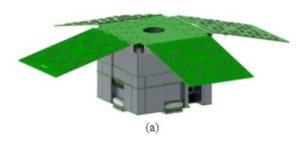
DORA Payload 1u module

(a) Shown in full with optical receiver panels deployed. 

DORA Payload 1u module
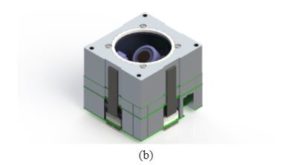
(b)  Shown with receiver panels hidden.  The actuated mirror for steering the transmitter laser is visible through the top face.

DORA Payload 1u module
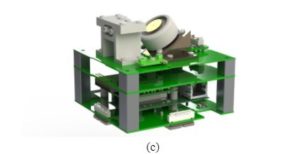
(c) Shown with panels and thermal shields hidden, revealing the analog and digital processing boards.

Rendering of full cubesat
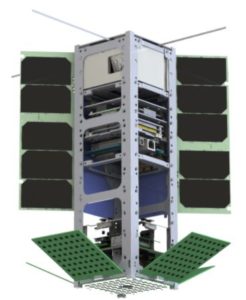
The DORA payload is at the bottom and shown with the aluminum shell hidden.

Optical Ground Terminal
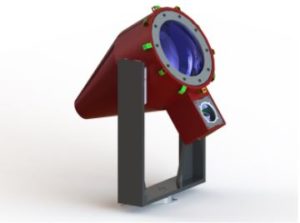
Unique optical transceiver, enabling high speed uplink and downlink with the DORA payload from the ground.

Transmitter and receiver terminals
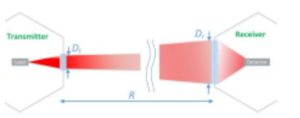
Image shows relevant parameters for DORA optical communications.


Publications

Papers, Posters, and Abstracts

  1. Talamante et al., Deployable Optical Receiver Array Cubesat, Proceedings of the Small Satellite Conference, SSC21-S1-35, 2021
  2. Hoffman et al., Creating Reliable Software Systems for the DORA CubeSat, Proceedings of the Small Satellite Conference, Technical Poster Session 6: Flight & Ground Software, 2021
  3. Jacobs et al., Plan for On-Orbit Demonstration of the Deployable Optical Receiver Array, 2022 IEEE Aerospace Conference
  4. Escobar et al., Development of a Deployable Optical Receive Aperture, 2022 IEEE Aerospace Conference
  5. Patel et al., Ground Terminal Evaluation for Deployable Optical Receiver Aperture (DORA), 2024 IEEE Aerospace Conference
  6. Lalonde et al., Integration and Delivery of the Deployable Optical Receiver Aperture (DORA) Cubesat, 2025 IEEE Aerospace Conference
  7. Zhao, et al., Pathfinding Low Frequency Radio Astronomy with the DORA Radio Background Experiment, 2025 IEEE Aerospace Conference
  8. DuBois et al., Effect of High Solar Activity on the Orbital Decay Rate of the 3U Cubesat DORA, 2025 Small Satellite Conference


Memoranda

Meet the DORA Team

Danny Jacobs, PI

My name is Danny Jacobs and I lead the MHz Astronomy Division space astronomy group in the School of Earth and Space Exploration at Arizona State University.

Judd Bowman, CO-I

Judd Bowman is an experimental cosmologist interested in the formation of structure in the early universe, including the first stars, galaxies, and black holes. His current research focuses on the development and deployment of technologies and techniques to enable observational probes of the redshifted 21 cm line of neutral hydrogen gas during the epoch of reionization.

Mickey Horn

I am a Research Technician focusing on the systems engineering design of the spacecraft. I’m also currently developing the first version of the flatsat.

Uriel Escobar

I have a Masters degree in Electrical Engineering from the University of California Riverside and have an interest in optical communication. I worked on developing and integrating the optical receiver and transmitter for DORA.

Andy Klaib

Andy Klaib is an electrical engineer in the Advanced RF & Optical Technologies group at JPL. He specializes in digital logic design, embedded systems, and programming. He is responsible for the payload’s FPGA design and communications software.

Michelle Patterson

Michelle Patterson is a Master’s student in Industrial Engineering. She has a background in project management, process improvement and quality control. Michelle is currently working as a project manager for the DORA Cubesat team.

Sean Cornish

My Name is Sean Cornish. I was born in Joliet, Illinois and raised in Southern California. I earned a B.S. in Engineering Physics from Biola University, and am now a Senior at the University of Southern California, concurrently working towards my B.S. and M.S. in Astronautical Engineering. I work at NASA’s Jet Propulsion Laboratory as an Engineering Undergraduate Student, where I develop and test a variety of Electrical and Mechanical designs for RF and Optical communication technologies. I was fortunate enough to join the DORA team in August of 2020, and have been handling the mechanical design and deployment of the payload.

ASU Interplanetary Initiative Lab

Christopher McCormick

Christopher is an Electrical Engineering undergraduate student at Arizona State University who focuses on RF and embedded systems. He also is a Research Aide for the Interplanetary Initiative Lab and currently is developing the Radio Communication System for the DORA Cubesat as well as assists in the development of the Attitude Determination and Control System Testbed.

Matthew Adkins

Matthew is a graduate student working towards his masters in mechanical engineering.  He currently works in the II Lab and plays a role in the development of test equipment for the DORA Cubesat project. Matthew is also conducting the thermal analysis of the DORA cubesat as part of his master program requirements. He is interested in space because he enjoys exploring unknown places and space is the ultimate unknown.

Chandler Hutchens

Junior in aerospace engineering (astronautics) working on the thermal vacuum design and testing for DORA cubesat at the Interplanetary Initiative Lab. Interested in satellite design and wants to be an astronaut!

DORA Alumni

Isabella All

My name is Isabella All, I am a third year undergraduate at ASU, majoring in Aerospace (Astronautical) Engineering. I am from Dayton, Ohio, and loving every minute in Arizona. I am a Student-Athlete, competing for ASU Swimming and Diving, and in Barrett, the Honors College. I was initially given the opportunity to join the Interplanetary Initiative Lab and work on this ADCS project for the DORA Mission in order to generate ideas for my Barrett Honors Thesis project. However, with the time I have invested thus far, I have gained more than just that. I have found more interest in small satellites and have hopes of building my professional career from this project, as well as building connections with the people I get to work with!

Parker Cohensitt

My name is Parker Cohensitt, and I am a senior at Arizona State University. I study Technological Leadership centered on space exploration. My interests include robotics, design, travelling, and astronomy. I have participated in a variety of projects including a data analyst for Nordita and the University of Iceland, to modify a codebase which studies information related to cosmic-ray data and gas emission line surveys. My most recent project was assisting in the design and layout of the solar simulator, a light source that represents the sun during testing, for the ADCS testbed of the DORA CubeSat project.

Amisha Patel

Computer Engineering graduate student at Arizona State University with concentration in embedded systems. I am a Research Aide (Student Worker) at Interplanetary Initiative Lab, currently working on development of testbed for Attitude Determination and Control System of DORA satellite.

Pawan Vijayanagar

I’m currently a senior pursuing mechanical engineering at Ira A. Fulton School of Engineering. I’m an active drone developer and I see my future in the UAS industry!

ASU Capstone Team

The capstone team is working to create prototype software systems for the DORA Cubesat. These software systems include both the flight software and the ground software. The goal is to develop a full ground-flight system that is as like-flight as possible for the time being. These software systems will lay the foundations for what will become the flight version of the respective systems.

Anish Katukam

Flight team member.

Justin Coylar

Flight team member.

Jah Markabawi

Ground team member.

Khyati Raka

Ground team member.

Evan Behrendt

Ground team member.